Why Businesses Are Moving Toward AI Agents
Businesses in 2026 are expected to handle larger volumes of data, customer interactions, and operational complexity than ever before.
AI agents help organizations by reducing manual work and increasing operational efficiency.
1. Faster Decision-Making
AI agents process thousands of data points within seconds and provide recommendations based on real-time insights.
Instead of waiting for reports, managers receive immediate suggestions that support faster business decisions.
2. Improved Customer Experience
Customers increasingly expect instant responses.
AI agents can provide:
- 24/7 support
- Personalized recommendations
- Faster issue resolution
- Consistent service quality
This leads to higher customer satisfaction while reducing support costs.
3. Higher Productivity
Employees often spend hours performing repetitive administrative tasks.
AI agents can automate:
- Email management
- Report generation
- Meeting scheduling
- Data entry
- Document processing
This allows employees to focus on strategic work rather than routine tasks.
4. Better Data Analysis
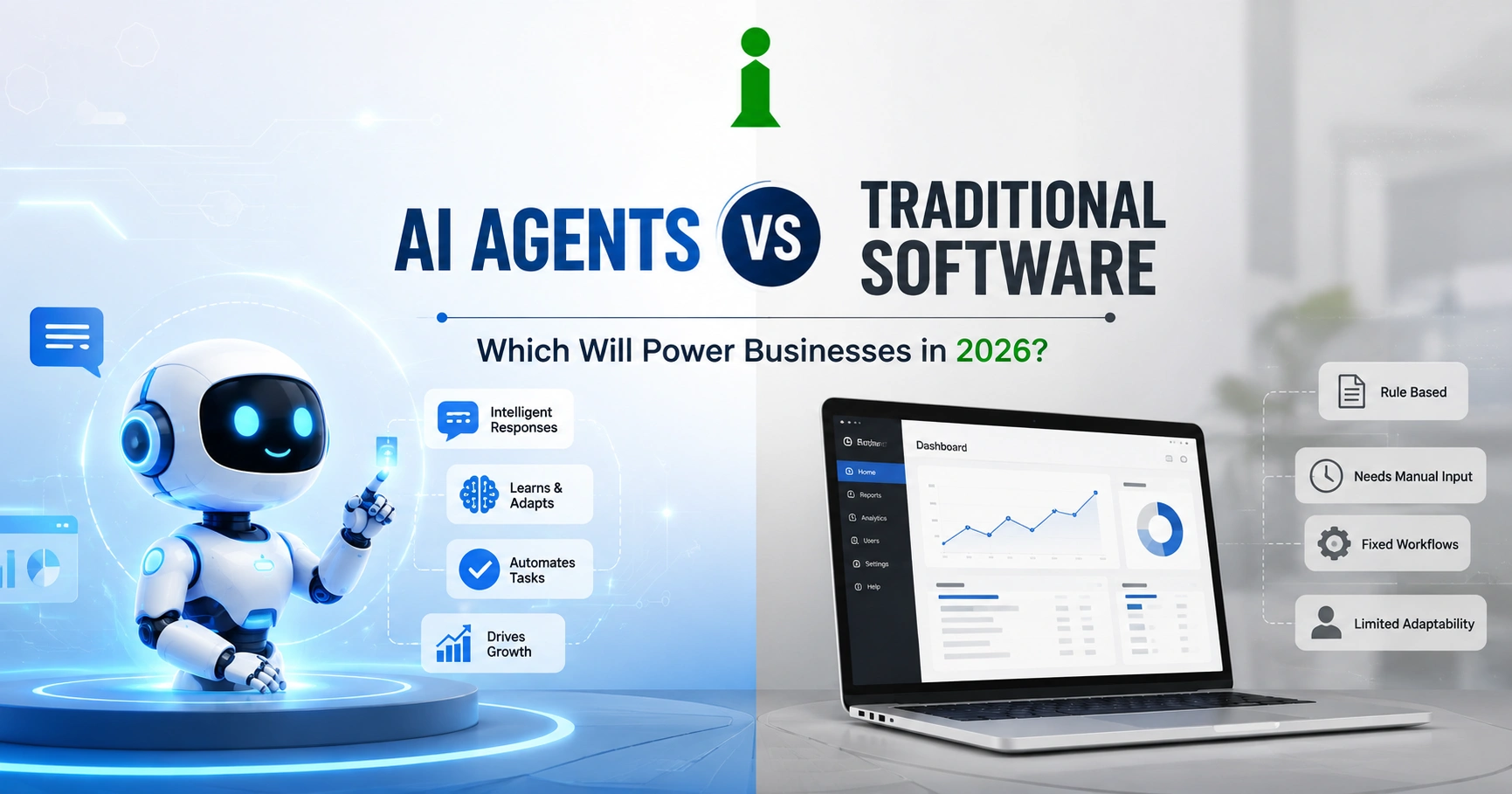
Traditional software stores information.
AI agents transform that information into actionable insights.
They can identify:
- Market trends
- Customer behavior
- Sales opportunities
- Operational bottlenecks
- Potential risks
Businesses can then make data-driven decisions with greater confidence.
Where Traditional Software Still Excels
Despite the excitement around AI, traditional software remains highly valuable.
Many business processes require predictable, rule-based execution.
Examples include:
- Financial compliance
- Payroll processing
- Tax calculations
- Regulatory reporting
- Database management
These functions prioritize consistency and accuracy, making traditional software the preferred choice.
Challenges of AI Agents
While AI agents offer significant advantages, businesses should also consider potential challenges.
Data Privacy
AI systems require access to quality data. Organizations must ensure strong security and compliance practices to protect sensitive information.
Implementation Costs
Deploying AI agents may involve upfront investments in infrastructure, integration, and employee training.
Human Oversight
AI agents can assist with decisions, but critical business judgments still require human review, especially in regulated or high-risk industries.
Industries That Will Benefit Most from AI Agents in 2026
Several industries are already seeing measurable value from AI-powered automation.
Healthcare
AI agents assist with appointment scheduling, patient support, medical documentation, and administrative workflows.
Finance
Banks and financial institutions use AI agents for fraud detection, customer service, and risk assessment.
Retail
Retailers leverage AI for personalized recommendations, inventory forecasting, and customer engagement.
Manufacturing
Manufacturers benefit from predictive maintenance, production optimization, and supply chain monitoring.
IT Services
Technology companies use AI agents for software testing, code assistance, incident management, and customer support.
The Future: AI and Traditional Software Working Together
Rather than replacing traditional software entirely, AI agents are likely to enhance existing systems.
Imagine an ERP platform powered by AI that not only stores business data but also predicts demand, automates approvals, and recommends operational improvements.
This hybrid approach combines the stability of traditional software with the intelligence of AI.
Businesses adopting this strategy can improve efficiency without replacing their entire technology stack.
How Businesses Should Prepare for 2026
Organizations looking to stay competitive should begin evaluating where AI can create the greatest value.
Consider the following steps:
- Identify repetitive workflows suitable for automation.
- Review existing software systems for AI integration opportunities.
- Train employees to work alongside AI tools.
- Start with pilot projects before scaling AI across the organization.
- Establish governance for data quality, privacy, and responsible AI use.
A thoughtful approach helps maximize benefits while minimizing implementation risks.
Final Thoughts:
The debate between AI agents and traditional software isn't about declaring one the winner. Instead, it's about choosing the right technology for the right purpose.
Traditional software will continue to provide the reliable foundation for many business operations, especially where consistency and compliance are essential. AI agents, on the other hand, bring intelligence, adaptability, and automation that can unlock new levels of productivity and innovation.
As we move into 2026, businesses that combine the strengths of both technologies will be best positioned to respond to changing customer expectations, streamline operations, and stay ahead of the competition. Rather than replacing existing systems overnight, the most successful organizations will integrate AI strategically, using it to enhance decision-making, automate repetitive work, and empower employees to focus on higher-value tasks.
The future belongs to businesses that view AI not as a replacement for traditional software, but as a powerful partner in digital transformation. By embracing this balanced approach, organizations can build smarter, more resilient, and future-ready operations.