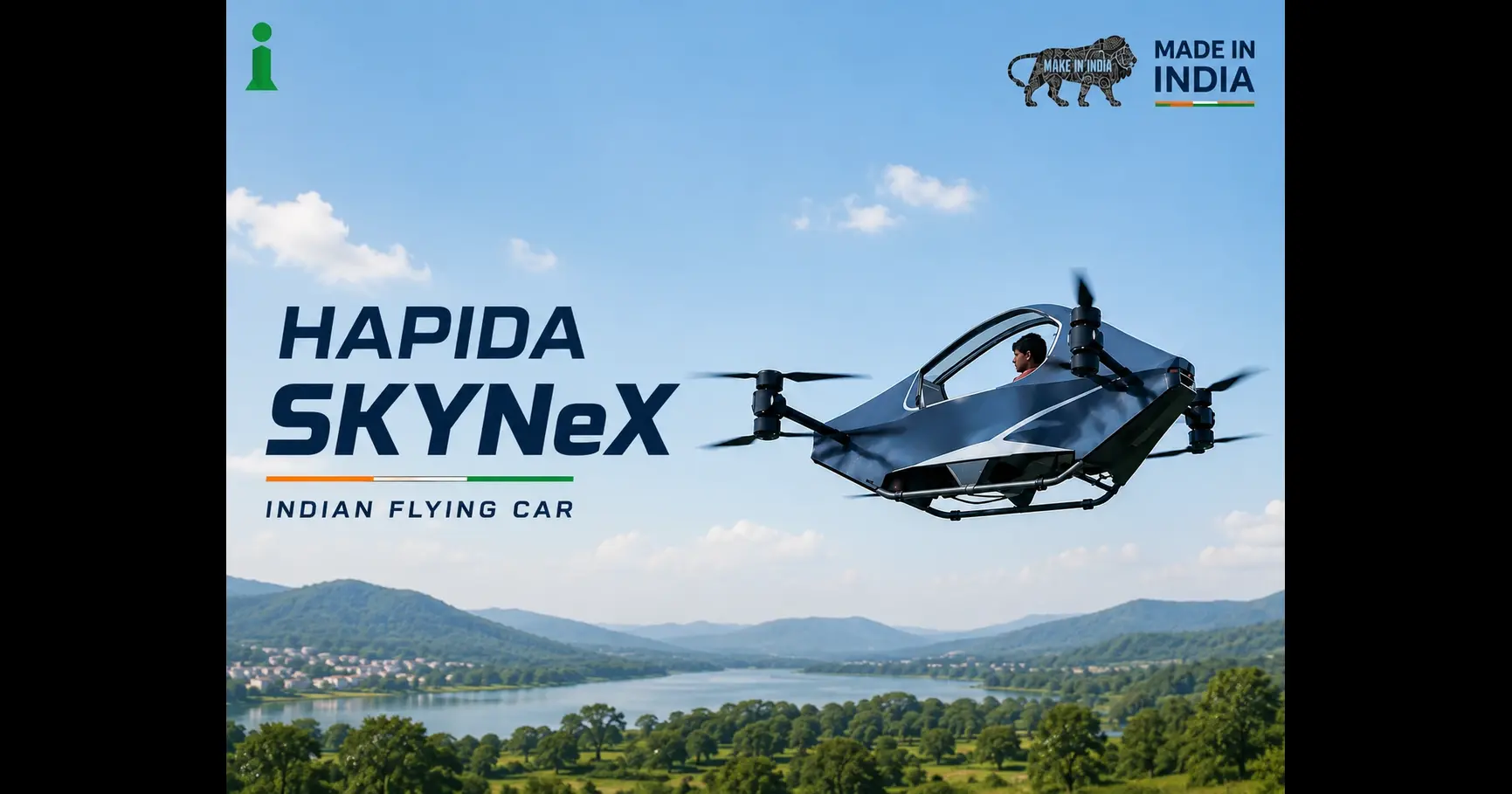
The idea of a flying car in India has always sounded like something from a science-fiction movie. But a recent innovation from Uttarakhand has brought that idea closer to reality.
Indian innovator Ravi Tamta has attracted attention with HAPIDA SKYNeX, a single-seat electric flying vehicle prototype developed under Hapida Sky. The prototype has been described in recent reports as being based on modified and enhanced drone technology and has undergone test flights in Almora, Uttarakhand.
What makes this innovation interesting is not simply that it can fly. The project combines several areas of modern technology, including electric propulsion, drone technology, sensors, embedded systems, flight-control software and mechanical engineering.
At the same time, it is important to understand that HAPIDA SKYNeX is still a prototype. It is not yet a commercially available flying car, and several technical, safety and regulatory challenges need to be solved before such vehicles can become a common form of transportation.
Who Is Ravi Tamta?
Ravi Tamta is an innovator and entrepreneur from Almora, Uttarakhand, and the founder of Hapida.
His work has focused on developing practical technology solutions for everyday problems, particularly those connected with rural and hilly regions. His previous innovation projects have included products such as a smart bamboo stick and mobile-chargeable shoes.
His background makes the HAPIDA SKYNeX project particularly interesting.
Uttarakhand is a mountainous state where travelling between two locations can sometimes take much longer because of winding roads, steep terrain and difficult geographical conditions.
This creates an interesting question: Could small electric flying vehicles eventually help improve transportation in mountainous regions?
That idea appears to be one of the interesting possibilities behind this type of innovation.
What Is HAPIDA SKYNeX?
HAPIDA SKYNeX is a single-seat electric flying vehicle prototype developed by Ravi Tamta and Hapida Sky.
According to recent reports, its design is based on modified and enhanced drone technology.
This is an important part of the innovation because modern drones already use several technologies that are useful for developing small flying vehicles.
These include:
- Electric motors
- Propellers
- Battery systems
- Sensors
- Flight controllers
- Embedded computers
- Real-time software
- Electronic control systems
The major difference is that a drone generally carries cameras, sensors or other equipment, while a human-carrying flying vehicle has to deal with much higher requirements for weight, stability, safety and reliability.
That makes the engineering challenge considerably more difficult.
How Does the Flying Vehicle Technology Work?
The exact technical specifications of HAPIDA SKYNeX have not been publicly documented in enough detail to confidently describe every component or performance figure.
However, the technology behind this type of vehicle can be understood through the systems commonly used in advanced drones and electric aircraft.
Drone Technology
Drone technology is at the heart of many modern personal flying vehicle concepts.
A multicopter drone uses multiple motors and propellers to generate lift. The flight-control system constantly adjusts motor output to help control movement and maintain stability.
For example, if the vehicle needs to tilt in a particular direction, the controller can change the speed of different motors.
This process happens extremely quickly.
For a human-carrying vehicle, the same basic concept needs to be developed with much greater attention to safety and reliability.
Electric Motors and Propulsion
HAPIDA SKYNeX has been reported as an electric flying vehicle.
Electric motors are attractive for small aircraft because they can provide high levels of controllable power while having fewer moving mechanical parts than traditional combustion engines.
However, electric aviation has one major challenge: battery weight.
A flying vehicle needs enough energy to generate lift and remain airborne. At the same time, the battery itself adds weight.
This creates a difficult engineering balance between:
- Battery capacity
- Vehicle weight
- Motor efficiency
- Flight time
- Power consumption
- Charging requirements
Improving battery technology will therefore be an important part of the future of electric flying vehicles.
The Importance of Flight-Control Software
One of the most interesting parts of a flying vehicle is the software controlling it.
A drone or electric aircraft cannot rely only on mechanical components. Its onboard computer needs to process sensor data and make rapid adjustments.
The system may monitor:
- Orientation
- Acceleration
- Movement
- Motor speed
- Pilot commands
- Battery status
- Flight conditions
This is where embedded systems and real-time programming become important.
The software needs to respond quickly because even a small change in the vehicle's position can affect stability.
This is also where technologies such as C, C++, Python, microcontrollers and real-time control systems can become relevant in the wider development of drones, robotics and autonomous machines.
Why Embedded Programming Matters
Embedded programming allows software to interact directly with hardware.
In a flying vehicle, software may need to communicate with sensors, controllers, motors and power-management systems.
This makes embedded systems an important part of modern aviation and robotics technology.
Sensors: The Hidden Technology Behind Flying Machines
When people look at a flying vehicle, they usually notice the motors and propellers first.
But sensors are equally important.
Sensors provide the computer with information about what the vehicle is doing.
Motion and Orientation Sensors
Inertial sensors can help determine acceleration, rotation and orientation.
Electronic Controllers
Electronic controllers process the information coming from sensors and send instructions to the propulsion system.
Battery Monitoring
Electric vehicles also need systems to monitor voltage, current, temperature and battery health.
Embedded Computing
An onboard computer can combine all this information and execute the software responsible for flight control.
This shows why a flying vehicle is not simply a mechanical machine.
It is a combination of:
Hardware + Electronics + Software + Sensors + Control Systems
Why Is Uttarakhand a Good Use Case for Flying Vehicles?
The geography of Uttarakhand creates a strong reason to explore alternative transportation technologies.
Mountain roads can involve:
- Long travel times
- Steep terrain
- Remote villages
- Difficult road construction
- Weather-related disruptions
- Limited connectivity
A flying vehicle could theoretically travel directly through the air instead of following winding roads.
However, that does not mean flying vehicles can immediately solve transportation problems in the mountains.
Weather conditions, landing areas, regulations, safety and operating costs would all need to be considered.
The real value of HAPIDA SKYNeX at this stage is that it demonstrates an attempt to explore whether such technology can eventually become practical.
Challenges Faced by Ravi Tamta
Building a flying vehicle is very different from building a normal automobile or consumer product.
Limited Infrastructure
Independent innovators often have to work with limited access to advanced laboratories, specialised testing equipment and aviation facilities.
Developing an aircraft requires controlled testing because even small engineering problems can become serious during flight.
For an innovator working outside a large aerospace company, this can make development significantly more difficult.
Safety
Safety is probably the biggest challenge for any flying vehicle.
A conventional car can stop on a road if its engine fails.
A flying vehicle does not have the same option.
Engineers have to consider different types of failure, including:
- Motor failure
- Battery failure
- Sensor failure
- Control-system failure
- Communication failure
- Structural problems
- Weather conditions
- Emergency landing
This is why a successful prototype flight is only an early step in the development process.
Battery and Energy
Battery technology is another major challenge.
Flying requires continuous energy.
The vehicle must be light enough to fly but also carry enough battery capacity to provide useful flight time.
This creates a difficult engineering equation.
Better batteries, lighter materials and more efficient electric motors could help improve the performance of future electric aircraft.
Is HAPIDA SKYNeX Really a Flying Car?
The phrase "flying car" is currently being used widely when discussing the project because it is easy for the public to understand.
Technically, however, it is more accurate to describe HAPIDA SKYNeX as a single-seat electric flying vehicle prototype.
It should also not be confused with a commercially available vehicle that can simply be driven on a normal road and then flown into the sky.
This distinction is important when discussing emerging technology.
For SEO purposes, "Indian flying car" is the natural search phrase, while "electric flying vehicle prototype" is a more technically accurate description.
What Technology Fields Are Connected to Flying Cars?
The development of flying vehicles brings together many different technology fields.
Software Development
Software is required for control systems, monitoring, communication and potentially autonomous functions.
Embedded Systems
Embedded computers and microcontrollers can control motors, sensors and other hardware.
Robotics
Flying vehicles share many technologies with robotics, particularly automation and real-time control.
Artificial Intelligence
AI could eventually be used for navigation, obstacle detection, route planning and autonomous flight.
IoT
Connected flying vehicles could potentially communicate with cloud platforms and other devices for monitoring and data analysis.
Electronics
Power management, motor controllers and sensors all depend heavily on electronics.
What Can IT Students Learn From This Innovation?
The HAPIDA SKYNeX story also highlights how broad the technology industry has become.
A student learning programming today may eventually work in industries such as:
- Robotics
- Automotive technology
- Drones
- AI
- IoT
- Automation
- Aerospace technology
- Smart mobility
Programming is no longer limited to websites and mobile applications.
Software is increasingly becoming part of physical products.
A drone, electric vehicle, robot or autonomous machine may contain thousands of lines of code working with sensors and hardware.
That is why learning programming and understanding emerging technologies can create opportunities across many industries.
The Connection With VAIR IT Technologies and VAIR IT Trainings
At VAIR IT Technologies, technology is not limited to traditional IT services.
Innovations such as HAPIDA SKYNeX demonstrate how software and hardware are becoming increasingly connected.
For students at VAIR IT Trainings, this type of real-world innovation can help explain why skills such as programming, AI, IoT and embedded systems are becoming important across different industries.
A student who begins with programming can later explore areas such as:
Programming ? Embedded Systems ? IoT ? Robotics ? AI ? Automation
The future technology ecosystem will increasingly require professionals who understand how these different areas work together.
Could Flying Cars Become Common in India?
It is still too early to know.
For flying vehicles to become common, several major challenges would need to be addressed.
Technology
Vehicles would need to become safer, more reliable and more energy efficient.
Infrastructure
Cities and rural areas would need suitable locations for take-off, landing, charging and maintenance.
Regulation
Aviation authorities would need appropriate rules covering certification, pilots, airspace and safety.
Cost
The technology would need to become financially practical.
Public Confidence
People would need to trust the safety of flying vehicles.
So, while prototypes such as HAPIDA SKYNeX are important, there is still a long journey between a successful test flight and everyday commercial transportation.
What Could Be Next for HAPIDA SKYNeX?
The next stage would involve continued testing, engineering improvements and further development.
Future versions could focus on areas such as:
- Better flight stability
- Improved battery efficiency
- Stronger safety systems
- More efficient motors
- Advanced flight-control software
- Better navigation
- Emergency systems
- Structural improvements
Regulatory requirements would also become increasingly important if the technology moves toward commercial use.
For now, the project should be viewed as an early-stage Indian flying-vehicle innovation rather than a finished transportation product.
Frequently Asked Questions
Who is Ravi Tamta?
Ravi Tamta is an innovator and entrepreneur from Almora, Uttarakhand, and the founder of Hapida. His work includes technology projects focused on solving practical problems.
What is HAPIDA SKYNeX?
HAPIDA SKYNeX is a single-seat electric flying vehicle prototype developed by Ravi Tamta and Hapida Sky.
Is HAPIDA SKYNeX India's first flying car?
It is safer to describe it as a new Indian flying vehicle prototype rather than definitively calling it India's first flying car. The term "flying car" is widely used in media coverage, but other flying-vehicle concepts have also been developed in India.
What technology does HAPIDA SKYNeX use?
Public reports describe the project as an electric flying vehicle based on modified drone technology. The broader technology areas include electric propulsion, sensors, flight-control systems, electronics and embedded software.
Can people buy HAPIDA SKYNeX?
No. It is currently a prototype and is not a commercially available flying car.
Final Thoughts
Ravi Tamta's HAPIDA SKYNeX is an interesting example of Indian innovation combining drone technology, electric propulsion, software, sensors and engineering.
It is still too early to say that flying cars are ready to become part of everyday transportation. Battery limitations, safety, regulations, infrastructure, cost and reliability remain major challenges.
But innovation often begins with experimentation.
What makes this project particularly interesting is that it connects a local challenge in a mountainous region with technologies that are being explored around the world.
For VAIR IT Technologies and VAIR IT Trainings, it also provides a useful example of where technology is heading.
The future of IT is not only about websites, applications and computers. AI, IoT, embedded systems, robotics, automation and software are increasingly becoming part of the physical world.
The flying car may still be at an early stage, but the technology behind the idea is already creating new opportunities for engineers, programmers and technology professionals.